
Chemical anchors enable high-strength fixings in all types of materials. Very easy to install, they offer high levels of safety and great durability in all types of applications.
In our range of chemical anchors, you will find systems designed for new construction, renovation and structural anchoring, with formulations adapted to different substrates and installation conditions.
What are the advantages of a chemical anchor (and how does it differ from a mechanical anchor)?
A chemical anchor consists of a resin that is injected into the base material and, as it hardens, fixes the rod or metal element to the substrate by adhesion. Unlike mechanical expansion systems, chemical anchors do not generate radial pressure on the base material, which reduces the risk of cracking, improves stress distribution around the drill hole and allows work to be carried out closer to edges and other anchors.
Main advantages of chemical anchors
- Greater adhesion surface: the mortar completely fills the drill hole, increasing the effective anchoring area.
- High load-bearing capacity in concrete, solid brick and hollow substrates (in the latter, combined with sieves).
- Lower radial stress on the substrate as it does not work by expansion.
- Greater freedom to position the anchor: facilitates work close to edges, joints and other anchors.
- Corrosion protection: the rod is embedded in the resin, reducing its exposure.
- Modular capacity: it is possible to adjust the strength of the anchor by varying the diameter of the rod and the depth of penetration into the base material, following the manufacturer’s tables.
- Good performance in demanding conditions: specific formulations allow work to be carried out in the presence of vibration, humidity or a certain degree of substrate instability, provided that the installation conditions are respected.
Limitations and aspects to be taken into account
- They require a curing time before the load can be applied; they are not an immediate load solution.
- They are more sensitive to correct execution: cleaning of the drill hole, mixing, handling and curing times.
- Performance depends on the application temperature and the condition of the product (storage, expiry date).
- In simple, low-responsibility fixings or where immediate commissioning is required, a mechanical anchor may be quicker.
How to install chemical anchors correctly
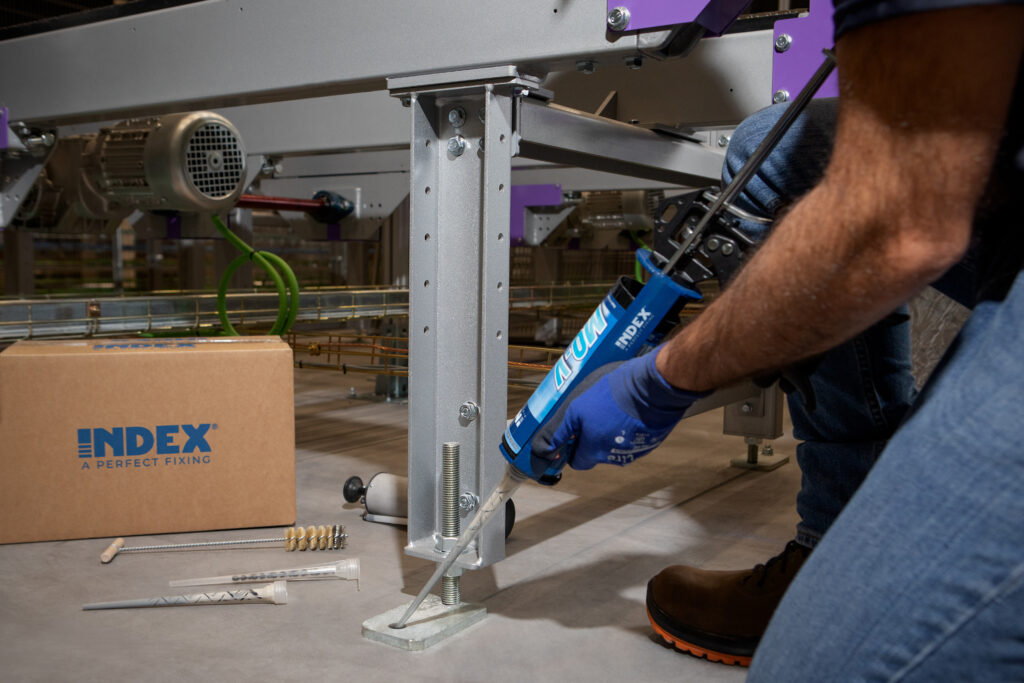
The installation of a chemical anchor requires following a defined procedure to ensure that the system performs as specified by the manufacturer. It is not just a matter of drilling a hole and injecting resin, but also of respecting the dimensions of the hole, the preparation of the substrate, the application of the mortar and the curing times. The key aspects to be taken into account in order to carry out the installation correctly and ensure the expected performance of the anchor are explained below.
Definition of the anchor according to technical tables
The process always begins with the definition of the anchor based on the manufacturer’s technical tables. The diameter of the rod is determined based on the base material (concrete, hollow masonry, block, etc.) and the required load. This parameter determines the diameter of the drill bit, the depth of the hole and, where applicable, the need to use a screen.
All these installation conditions are part of the tested system; therefore, working outside the ranges and configurations indicated in the tables means that the fastening cannot be guaranteed to achieve the performance described in the technical documentation, especially in structural or high-responsibility applications.
Drill preparation and use of sieves
Once the anchor has been defined, drilling is carried out with the appropriate drill bit and the hole is cleaned. The sequence of brushing and blowing (or, at a minimum, vacuuming) is essential to remove dust and loose material that would reduce the adhesion of the resin to the substrate.
Tests show that a dirty drill bit can reduce the fixing capacity to less than a third of the expected value, so an uncleaned hole can compromise the performance of the anchor, even if the resin and rod are suitable.
In hollow substrates, it is also mandatory to use sieves to prevent resin loss inside the brick or block and to concentrate the mortar in the effective anchoring area. Plastic sieves confine the product and improve adhesion to the material, while threaded metal sieves allow for removable solutions using rods or metric screws, maintaining the chemical fixing as a base.
Application of mortar and insertion of the rod
With the drill prepared, the cartridge is mounted on the applicator and a mixing cannula is used to ensure even dosing. The first portion of the product must be discarded until a uniform mixture is obtained, ensuring the correct proportion of components. The resin is injected from the bottom of the drill hole (or sieve) towards the mouth, avoiding the formation of air pockets.
Next, insert the rod or stud with a slight twist during insertion. This twist helps to distribute the chemical mortar around the thread and improves the wetting of both the rod material and the substrate, optimising the adhesion surface. The rod must be positioned at the depth specified in the technical data sheet.
Handling and curing times
Each chemical mortar has a handling time and a curing time defined in the technical data sheet. The rod must be inserted within the open time, while the product is still workable; if this is done later, the resin will have started to set and adhesion will be compromised.
Once the anchors have been installed, the specified curing time must be fully respected before applying any load. This time is crucial to ensure that the resin reaches the expected strength values. In demanding fastenings, it is also advisable to respect the tightening torque specified by the manufacturer so as not to introduce additional stresses into the system.
Common installation errors and how to avoid them
Most failures in chemical anchors are due to deviations from the technical data sheet, not the product itself.
- Mistake: Using a drill bit diameter other than the one specified.
- How to avoid it: Use the drill bit indicated in the table for that rod diameter and resin (not ‘equivalents’).
- Mistake: Not following the drill cleaning sequence.
- How to avoid it: Brush and blow (or vacuum) before injecting.
- Mistake: Not purging the cartridge / not discarding the first mixture.
- How to avoid it: Purge until you see a homogeneous mixture and discard the first bead.
- Mistake: Inserting the rod outside the handling time.
- How to avoid it: Insert the rod within the indicated ‘working time’ (depending on temperature) and without pauses.
- Mistake: Applying load before the curing time is complete.
- How to avoid it: Do not load until the curing time (adjusted to the temperature) is complete.
- Mistake: Not using sieves on hollow substrates.
- How to avoid it: Always use a sieve on hollow bricks/blocks (diameter/length according to table).
- Mistake: Choosing a resin that is not suitable for the substrate or the level of responsibility.
- How to avoid it: Select resin according to substrate and requirements (and always within the manufacturer’s approved/tested range).
Types of chemical anchors available and when to use each one
Chemical anchors are formulated to respond to different levels of mechanical requirements and different types of substrates. The INDEX catalogue includes hybrid, polyester, vinyl ester and epoxy resins, each with specific properties that allow the anchor to be adapted to the conditions of the job site.
- Hybrid resins: combine vinyl ester and modified epoxy technologies to balance mechanical performance and fast curing times. Their stable behaviour in non-cracked concrete and brick makes them a versatile option for medium-high loads. MO-VH hybrid vinyl ester, designed for multi-purpose anchors in new construction and renovation, with good adhesion, medium-high chemical resistance and fast curing suitable for indoor and outdoor installations.
- Polyester resins: recommended for light construction and non-structural fixings, thanks to their easy application and short curing times. They work particularly well in brick and hollow substrates when the expected loads are low. The MO-P+ Polyester Plus formulation is commonly used in metalwork and less demanding installations, offering an economical and easy-to-apply solution.
- Vinylester resins: provide superior chemical and thermal resistance to polyester, making them suitable for concrete, solid substrates and more demanding environments. They offer high adhesion and consistent performance outdoors or in areas subject to thermal variations. MO-V Vinylester chemical anchoring is ideal for fixings that require robust and reliable mechanical performance.
- Epoxy resins: provide maximum adhesion and stability in high-responsibility anchors, especially in cracked concrete or applications with high loads. They are the right choice when maximum mechanical performance and permanent behaviour in critical conditions are required. The MOPURE Pure Epoxy 1:1 system represents this category, offering very high strength fastening for structural anchors.
These formulations allow the appropriate chemical system to be selected according to the substrate, the expected load and the environmental conditions of installation, ensuring a secure anchorage that is adapted to the technical requirements of the project.
Selecting the right system for the substrate
The choice of chemical anchor depends on the type of substrate and the expected load. In hollow substrates or perforated brick, the use of sieves is essential to contain the resin and ensure stable anchoring. In concrete, especially in cracked areas or areas subject to vibration, vinyl ester and epoxy formulations offer more reliable performance.
For light construction or non-structural assemblies, polyester is a quick and economical option that guarantees an adequate level of safety.
Knowing the characteristics of the substrate and the requirements of the project allows you to select the most suitable system, ensuring reliable installation and consistent performance on site.
Would you like to learn more about this topic? Access the recording of the INDEX Academy training course on chemical anchors given by Gonzalo Velilla, technical engineer at INDEX.