
Choosing the right solar panel mounting system is a decision that directly affects the safety, performance and service life of a photovoltaic installation. The same solar panel can be installed on a flush-mounted, tilted or ballasted structure, and choosing the wrong option can increase installation time, make maintenance more difficult or reduce energy output.
Although much of the attention is often focused on the photovoltaic modules themselves, the structure supporting them plays an equally important role. It must withstand wind, snow, thermal expansion and corrosion for decades, ensuring that the panels remain securely fixed under all conditions.
The main types of solar panel mounting systems are:
- Flush-mounted systems, recommended for pitched roofs with a favourable orientation.
- Tilted mounting systems, ideal for flat roofs and also for pitched roofs when the aim is to adjust the tilt angle or improve module orientation.
- Ballasted mounting systems, used on flat roofs where penetrating the surface is either not possible or not desirable, provided the structure can support the additional ballast weight.
Choosing between these systems depends primarily on the type of roof, but also on its pitch, orientation, whether penetrations can be made, structural loads and the environmental conditions at the installation site.
At INDEX, we develop fastening systems for photovoltaic installations on flat, metal and tiled roofs, giving us first-hand knowledge of the factors that influence the choice of mounting structure and the requirements it must meet to provide a safe, durable installation.
In this guide, we examine the differences between each type of mounting system, their most common applications and the key aspects to consider when choosing the most suitable solution for each installation.
What types of solar panel mounting systems are available?
The structure on which photovoltaic panels are installed must be suited both to the characteristics of the roof and to the requirements of the installation.
In general, flush-mounted systems are the most common solution for pitched roofs, as they make use of the roof’s existing pitch. Tilted mounting systems, on the other hand, allow the module tilt angle to be adjusted to optimise orientation or to install panels on flat roofs. When the roof surface cannot or should not be penetrated, ballasted mounting systems provide stability using concrete blocks or other weighted elements.
The following table summarises the main differences between the different types of solar panel mounting systems.
| Mounting system | Recommended roof | Roof penetrations required? | Module tilt | Main advantage |
| Flush-mounted | Pitched roofs | Usually yes | Parallel to the roof | Simple installation and discreet visual integration |
| Tilted | Flat roofs or pitched roofs where the tilt angle needs to be adjusted | Yes, or secured to ballast | Adjustable or fixed | Optimises orientation and performance |
| Ballasted | Flat roofs | No | Usually between 10° and 15° | Preserves roof waterproofing |
Below, we look at the characteristics of each system to understand when each solution is most suitable.
Tilted mounting systems
Tilted mounting systems are designed primarily for photovoltaic installations on flat or very low-pitched roofs. Their main advantage is that they allow panels to be positioned at the most suitable tilt angle to maximise solar irradiation capture, which would not be possible if the modules were installed parallel to the roof.
A common example is industrial buildings with almost horizontal roofs. On this type of building, installing the panels directly parallel to the roof would reduce their performance and encourage water and dirt to accumulate. A tilted mounting system raises the modules and allows them to be oriented to improve energy output.
However, this type of mounting system is not limited to flat roofs. It can also be used on pitched roofs where the roof orientation is not ideal or where the panel tilt angle needs to be increased to optimise annual performance.
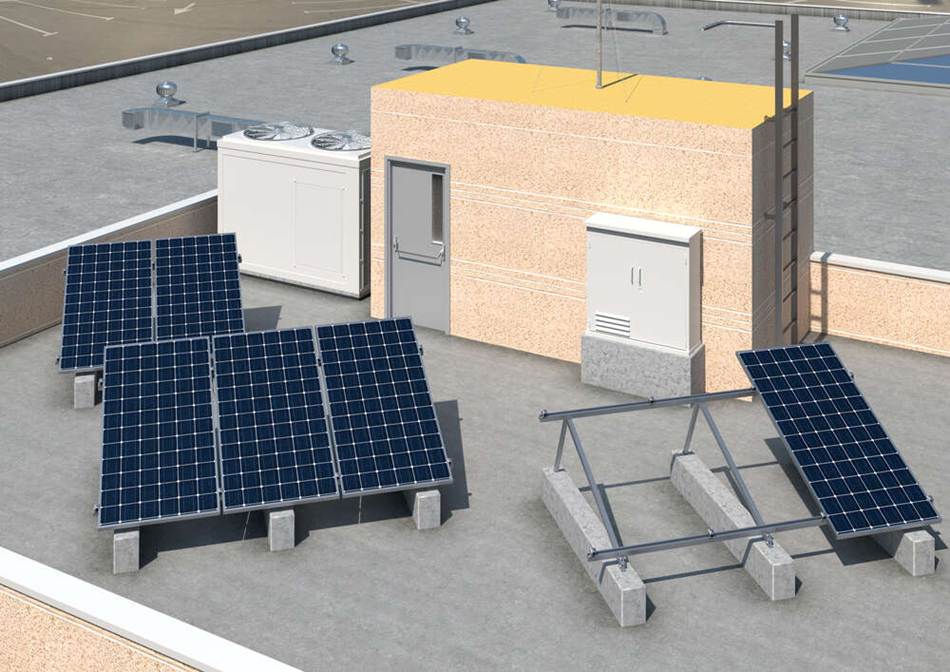
Our range includes tilted mounting systems with adjustable angles of 25°, 30° and 35°, as well as fixed-angle versions available from 5° to 35°, allowing them to adapt to different project configurations.
Another advantage of these systems is their installation flexibility. Depending on the roof characteristics, they can be mechanically fixed to the substructure or installed on concrete blocks using ballasted systems.
Main advantages of tilted mounting systems:
- They allow the panel tilt angle to be optimised.
- They improve solar irradiation capture when roof orientation is not ideal.
- They are suitable for flat roofs and certain pitched roofs.
- They can be installed using mechanical fastening or ballasted systems.
Flush-mounted systems
Flush-mounted systems are the most widely used solution for photovoltaic installations on pitched roofs. With this system, the panels are installed parallel to the roof surface, taking advantage of its natural pitch while achieving more discreet visual integration.
This type of mounting system is commonly used on homes, commercial buildings and industrial facilities with metal or tiled roofs whose orientation is already suitable for achieving good energy performance.
Depending on the type of roof, the structure can be secured using different accessories, such as trapezoidal sheet supports, standing seam fasteners, adjustable hanger bolts or tile hooks. This versatility allows the system to be adapted to virtually any type of pitched roof.
Flush-mounted systems are available in two main configurations: continuous profiles and discontinuous profiles.
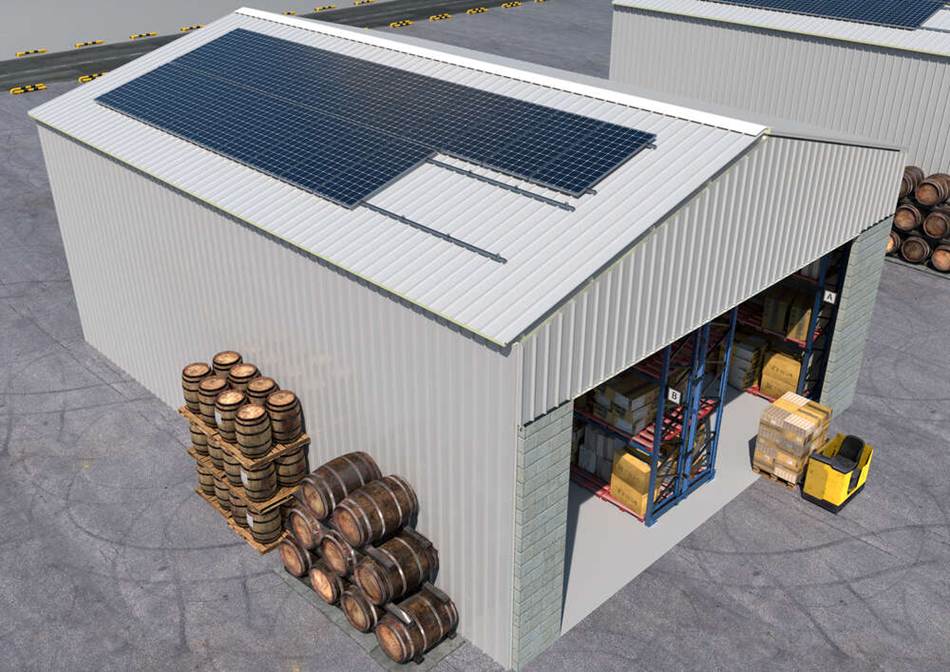
Continuous profiles
This system uses a continuous longitudinal profile onto which the photovoltaic modules are subsequently fixed. The continuous support surface makes setting out easier during installation and reduces the number of on-site adjustments required.
In addition to simplifying installation, it can be used on both metal and tiled roofs, making it the most common option for most projects.
Discontinuous profiles
Discontinuous profiles can also be used on metal roofs. Instead of installing a continuous profile beneath the entire row of panels, short profile sections are placed only at the points where fastening is required.
This solution reduces aluminium or steel consumption and lowers the overall weight of the structure, which can be particularly beneficial for large installations. The trade-off is that it requires more precise setting out and greater planning during installation, as each support must be positioned exactly where specified.
For this reason, it is mainly used on industrial metal roofs, where the material savings offset the additional setting-out time.
Main advantages of flush-mounted systems:
- They make use of the roof’s existing pitch.
- They provide quick and straightforward installation.
- They can be adapted to metal and tiled roofs using specific accessories.
- Discontinuous profiles can reduce material consumption on certain projects.
Ballasted mounting systems
Ballasted mounting systems are designed for flat roofs where making penetrations in the roof is either not possible or not advisable.
Instead of being mechanically fixed to the roof, system stability is achieved using concrete blocks or other weighted elements, calculated to withstand wind loads without compromising the building’s watertightness.
This type of solution is common on logistics buildings, shopping centres and industrial facilities with waterproofed roofs, where preserving the roof membrane is a priority.
Modern ballasted systems allow modules to be configured in both south-facing and east-west layouts, typically with tilt angles of 10° and 15°, helping to optimise the use of available roof space.
However, before choosing this type of structure, it is essential to check that the roof can support the additional ballast weight, as this determines whether the system is structurally viable.
Main advantages of ballasted mounting systems:
- No roof penetrations are required.
- They reduce the risk of water ingress.
- They enable quick installation on flat roofs.
- South-facing and east-west configurations are available to optimise space.
Types of solar panel mounting systems by material: aluminium vs steel
In addition to the design of the structure, the material from which it is manufactured also affects factors such as weight, corrosion resistance, ease of installation and project cost.
Aluminium and steel are the most widely used materials in photovoltaic installations. Both provide high mechanical strength and a long service life, although each is better suited to specific requirements.
The following table summarises their main differences:
| Feature | Aluminium | Steel |
| Weight | Very lightweight | Heavier |
| Handling | Easy to transport and install | More robust |
| Corrosion resistance | Very high | Depends on the coating |
| Structural rigidity | High | Very high |
| Price | Higher | More competitive |
| Typical applications | Residential and commercial installations | Industrial installations and special structures |
As with the type of mounting system, there is no single material that is best for every project. The choice will depend on the installation environment, roof type and the specific requirements of each project.
Aluminium mounting systems
Aluminium is the most widely used material for solar panel mounting systems thanks to its excellent balance of weight, mechanical strength and corrosion resistance.
Its low weight makes it easier to transport and handle during installation, reducing both the physical effort required by installers and the permanent loads placed on the roof. It also offers excellent resistance to oxidation, making it an attractive choice for outdoor installations.
However, not all aluminium performs equally well in aggressive environments. For installations close to the sea or exposed to high-salinity atmospheres, anodised aluminium is recommended because it provides additional protection against corrosion.
While anodised aluminium maintains a 25-year warranty both in indoor environments and in areas located less than five kilometres from the coast, the warranty for non-anodised aluminium is reduced in these environments due to their greater environmental aggressiveness.
For this reason, when selecting a mounting system, it is important to consider not only the type of roof but also the environmental conditions to which the structure will be exposed throughout its service life.
Aluminium is recommended when:
- The installation is on a roof where weight is an important factor.
- A lightweight, easy-to-handle structure is required.
- The project is located in humid environments or near the sea, using anodised aluminium.
- High corrosion resistance with minimal maintenance is a priority.
Steel mounting systems
Steel is an excellent alternative when a robust structure or a cost-effective solution with high mechanical performance is required.
Its greater rigidity makes it a widely used material in industrial installations and projects where long spans need to be covered or more complex geometries accommodated.
In these cases, the quality of the coating is just as important as the material itself.
INDEX solar mounting systems use steel profiles with an ATLANTIS C4-M coating, developed to provide high corrosion resistance in outdoor environments. Depending on environmental conditions, this system provides warranties of up to 25 years in C3 environments, 15 years in C4 and 5 years in C5 environments, where corrosivity is particularly high.
One of the most versatile products in the range is the GP-XS profile. Unlike other standard profiles, it can be cut at 125 mm intervals, making it possible to create virtually custom-made structures without requiring special components. This is particularly useful for industrial installations with obstacles, skylights, changes in geometry or unconventional layouts.
For these projects, having an adaptable profile simplifies installation, reduces waste and provides greater design flexibility.
Steel is an excellent option when:
- A particularly rigid structure is required.
- Optimising installation costs is a priority.
- The structure needs to accommodate complex geometries.
In any case, the decision between aluminium and steel should not be based solely on material price. Factors such as corrosion, ease of installation, installation time, expected service life and maintenance requirements will have a much greater impact on the installation’s long-term performance.
Mistakes to avoid when choosing a solar panel mounting system
Making the wrong choice when selecting a mounting structure can complicate installation, increase costs or reduce the service life of the photovoltaic system.
Below are some of the most common mistakes and how to avoid them.
Choosing the mounting system without assessing the roof first
The first step should always be to assess the characteristics of the roof.
It is not enough to know whether the roof is flat or pitched. You also need to consider the material on which the system will be installed, its pitch, orientation, the condition of the substructure and the loads it can support.
For example, two apparently similar metal roofs may require completely different solutions if one consists of sandwich panels and the other uses standing seam metal sheets.
Carrying out this assessment beforehand makes it possible to select the most appropriate fastening system and avoid modifications during installation.
Failing to consider panel orientation and tilt
It is often assumed that modules should simply follow the pitch of the roof. However, this does not always deliver the best energy performance.
When the roof orientation is not ideal or its pitch is insufficient, a tilted mounting system can significantly improve solar energy capture by allowing the panel angle to be adjusted.
Before choosing a mounting system, it is therefore important to assess whether the roof orientation will deliver the expected performance.
Choosing the material based solely on price
The mounting structure represents only a small proportion of the total investment in a photovoltaic installation, yet it has a direct impact on its durability.
Choosing a cheaper material without considering the installation environment can lead to a higher risk of corrosion, more frequent maintenance or even the need to replace components prematurely.
In coastal areas or aggressive environments, for example, anodised aluminium provides clearly superior corrosion resistance. Likewise, for industrial installations requiring high structural rigidity, steel with an appropriate coating may be the most suitable alternative.
The decision should always be based on the total life-cycle cost of the installation, rather than solely on the initial purchase price.
Failing to check whether the roof can support a ballasted system
Ballasted mounting systems avoid penetrations through the waterproofing layer, but they add extra weight that the roof must be capable of supporting.
Before choosing this system, it is essential to verify the building’s load-bearing capacity and ensure that the ballast required to provide stability will not compromise the existing structure.
Failing to plan for future extensions or maintenance
Companies and industrial facilities often increase their installed capacity to meet new energy requirements or add new equipment to the roof.
Choosing a mounting system from the outset that facilitates future extensions can therefore significantly reduce intervention times and future costs.
Sufficient space should also be provided to access the panels for maintenance, cleaning or component replacement.
Prioritising material savings over installation time
Reducing the amount of profile material used can lower the cost of the structure, but it does not always reduce the overall project cost.
For example, discontinuous profiles can optimise material consumption on certain metal roofs, but they require more precise setting out and longer installation times. A continuous-profile system, by contrast, may use slightly more material but can significantly speed up installation and reduce the risk of on-site errors.
The choice should therefore take into account both material costs and the installation hours required to complete the project.
How to choose the right mounting system for a photovoltaic installation
As we have seen, there is no single mounting system that is suitable for every installation. The right choice will always depend on the characteristics of the project and the conditions the structure will face throughout its service life.
As a general guideline:
- If the roof is pitched and has a favourable orientation, a flush-mounted system will usually be the preferred option.
- If the panel tilt angle needs to be adjusted or the roof is flat, a tilted mounting system generally provides the best balance between performance and versatility.
- When penetrating a flat roof is not possible, a ballasted mounting system is usually the most suitable alternative, provided the roof can support the system’s weight.
From there, the choice of material—aluminium or steel—should be adapted to the installation environment, anticipated loads and the specific requirements of each project.
Ultimately, taking the time to select the right mounting structure during the design phase not only simplifies installation but also helps improve system performance and minimise maintenance requirements for decades.
Need help choosing the right mounting system?
At INDEX, we develop fastening solutions for solar installations on metal and tiled roofs, with flush-mounted, tilted and ballasted systems designed for different project types.
Discover our range of solar panel mounting systems or contact our technical team for advice on selecting the most suitable solution for your installation.