
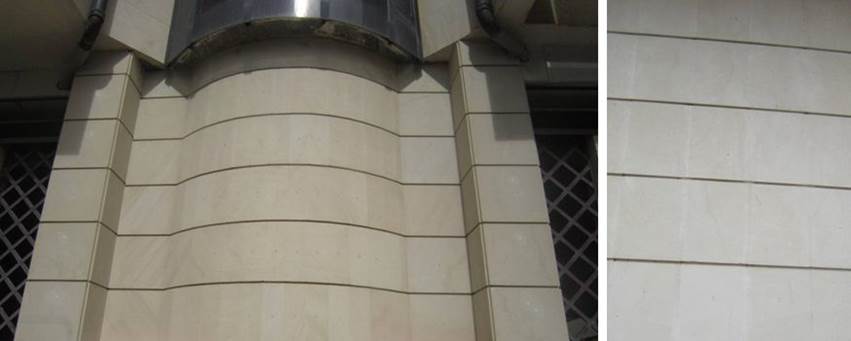
Over time, it’s common for stone cladding originally bonded with mortar to suffer from detachment problems. This phenomenon is mainly caused by freeze-thaw cycles, temperature variations, and the natural ageing of the materials, which can lead to a serious risk of pieces becoming detached.
Reinforcement using mechanical anchors
The most immediate and secure solution is to reinforce the fixing of each panel by installing a minimum of two mechanical anchors, although the final number will depend on the weight of the piece and the wind loads to which the façade is exposed.
The most common system uses high-performance plugs with European approval (CE marking), for example, the T-NUX with European approval ETA 14/0467, suitable for all types of base material, from solid substrates (such as concrete, solid brick or cellular concrete) to hollow substrates (such as perforated or hollow brick). The use of a 10 mm diameter plug is recommended.
In solid materials, the anchor expands and fixes itself internally in the base element; on the other hand, in hollow materials, the plug expands and, in the presence of a cavity, knots itself onto the inner face of the brick, thus ensuring secure fixing in any type of material.
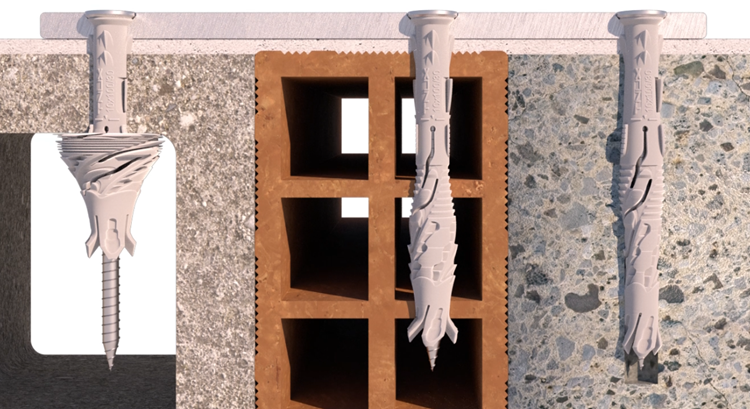
Installation process
The procedure for refurbishing or reinforcing the panels involves the following steps:
- Drilling: Drill the panel with a Ø10 mm drill bit to the depth indicated in the technical data sheet and European standard.
- Countersinking: a countersink is made on the face of the cladding using a larger diameter drill bit to completely accommodate the screw head.
- Placing the anchor: Insert the plug with its screw and tighten the screw.
- Aesthetic sealing: Once the screw has been embedded in the panel, a finishing putty (usually provided by the stone supplier) is applied, with a shade identical to that of the cladding, so that the anchor is completely concealed.
Recommended models
Among the different variants available, the following are recommended:
- T-NUX A: nylon dowel with zinc-plated countersunk screw. If this model is selected, you must ensure that no water will enter through the screw head, or the interface between the cladding and the base material, as this could cause corrosion of the screw
- T-NUX A4: nylon dowel with countersunk A4 stainless steel screw (AISI 316).
| T-NUX A | T-NUX A4 |
Selection of anchor length
The length of the anchor will depend on the thickness of the cladding. The most commonly used sizes are:
- T-NUX countersunk 10×80 mm, for cladding with a maximum thickness of 10 mm.
- T-NUX countersunk 10×100 mm, for cladding with a thickness of 10 to 30 mm.
These values represent the most common configurations in façade rehabilitation and reinforcement projects with façade cladding.
Last revision: FAQ56 rev0