
Anchors whose operating principle is mechanical interference, such as concrete screws, allow for rapid installation. In addition to this, since they do not have any expansion element, they can be removed just as easily. This has led the market to highlight the reusability of these products as one of their main advantages. While we can accept the veracity of this claim, there are certain aspects that must be considered before reusing these products.
We will use a THE concrete screw to show all the aspects to be considered in this regard. When installing the product for the first time, the product installation instructions contained in the European Type Approval (ETA) and in the product data sheet must be followed.
Among the aspects to be considered in relation to the reusability of this type of product, the most important is that once the product has been installed for the first time, it cannot be removed if we want to maintain the performance guarantees established in the ETA. In other words, any reuse of the product, even in the same hole, cannot guarantee the resistance values established in the aforementioned INDEX technical documentation.
So why is there talk about reusing this product?
When can a concrete screw be reused?
Anchors are often used for temporary applications such as securing props, formwork, tents, and similar elements. In these cases, the user might prefer to reuse a concrete screw, which allows for multiple uses and, moreover, leaves a clean, unobstructed surface when the product is removed, as no part protrudes.
For these specific applications, INDEX provides the Technical Suitability Document (DIT) for the concrete screw. Thanks to this additional evaluation, the THE screw has been validated for reuse in certain temporary fixings in concrete, provided that the installation and control conditions indicated in the document are met.
How many times can concrete screws be reused?
So, can I reuse the concrete screw as many times as I want? The answer to this question will always be no!
The second most important aspect to keep in mind when reusing these products is that each time they are reinstalled, their thread gets worn and loses diameter each time it is reused. This has a direct impact on the properties of the product, dramatically decreasing its performance, especially its tensile strength.
How can I check if a concrete screw is still suitable for reuse?
Before each reuse, it is necessary to verify that the screw is in suitable condition for reuse. This involves visually checking for damage such as deformation, broken threads, corrosion, or adhered concrete fragments.
Additionally, the thread wear must be checked using the corresponding reusability gauges indicated in the DIT.
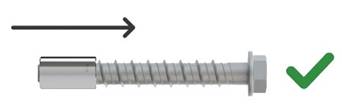
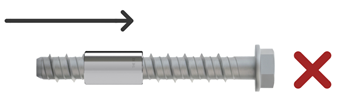
If, when the screw is inserted into its corresponding threaded hole, the threaded end does not protrude from the opposite end, it means the screw can be reused. However, the reused screw must always be installed in a new hole and following the usage conditions defined for temporary fixings. For these conditions, DIT specifies the required resistances based on the type of concrete used.
Otherwise, if the screw protrudes from the end of the gauge, it means that the product has reached maximum wear, so it should not be reused.
In conclusion, the most important aspects to consider are:
- Always follow the ETA’s instructions and the technical documentation.
- The services included in the ETA correspond to single-use facilities.
- The product can be reused in temporary fixations covered by DIT.
- Before each reuse, the condition of the screw and the wear of the thread must be checked as specified in the DIT, using the corresponding gauges.
- Do not reuse the screw in a hole where a screw has already been installed; it must always be installed in a new hole.
- Do not reuse screws that show visible damage, corrosion, broken threads, or wear exceeding acceptable limits.
- It cannot be reused an unlimited number of times.
Discover our range of concrete screw anchors.
Latest revision: FAQ13 rev0