
Developing climbing in a country where it barely exists is not just a sporting challenge—it involves creating infrastructure, building a community, and ensuring safety under particularly demanding conditions.
We spoke with Juan Luis Toribio, founder of the Jamrock Climbing project, to learn how climbing has evolved in Jamaica and the key role of rebolting in marine environments.
From the beginnings to building a community
Who is Juan Luis Toribio, and how did you end up developing climbing in Jamaica?
I’m a university professor of comparative literature and modern languages. I moved to Jamaica to teach Spanish and literature at a teacher training college in Montego Bay, as part of a program run by the Ministry of Foreign Affairs and AECID.
When I arrived, I had been climbing for about ten years, but I had never bolted a route nor considered doing so. I thought it was too complex and not particularly appealing. However, I soon discovered that there were hardly any climbing routes in the country—so if I wanted to keep climbing, I had to develop them myself.
Fortunately, the person I replaced introduced me to Daniel Oury, another Spanish climber who had already equipped the first routes in Jamaica. From the very first weekend, we started working together, and within a few weeks, we tripled the number of routes in the area he was developing.
When Dani left the country shortly after, I took over and continued equipping both in that area and in new sectors I discovered around Montego Bay.
How did Jamrock Climbing start, and what is its goal?
Jamrock Climbing was created to develop climbing as an accessible sport in Jamaica.
It’s a country with major inequalities, where activities like diving, golf, or horseback riding are out of reach for much of the population. My goal was not only to promote climbing but to offer it free of charge.
To achieve this, we organize introductory workshops, distribute equipment, and work on building a local community that can carry the project forward in the future.
How would you describe the climbing scene in Jamaica today?
Although it is still in an early stage, growth has been very significant! When I arrived, there were only a small number of low-grade routes in a single sector on the north coast and there were no local climbers. Today, there are more than 150 routes of all levels spread across different sectors of the country.
In addition, a community of around 200 local climbers has been created, both on the north and south coasts. Some of them are already developing new areas and organizing weekly sessions.
An important step in consolidating this growth was the construction of an artificial wall in the national stadium, thanks to an agreement with Adidas and the Rita Marley Foundation.
What makes climbing in places like Discovery Bay or Coral Springs special?
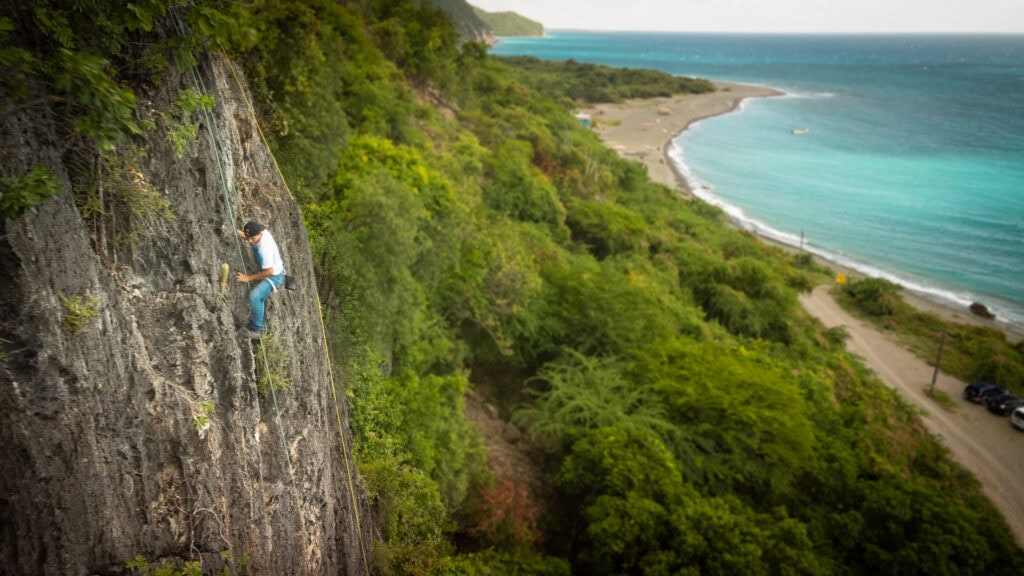
Many climbing areas are set in spectacular environments, deep in tropical jungle or above the Caribbean Sea. In places like Discovery Bay or Coral Springs, cliffs act as true balconies over turquoise waters. You can even spot sea turtles, and the sea breeze keeps temperatures pleasant even during the hottest hours.
Climbing in Jamaica: safety and deterioration
What issue are you currently addressing?
Due to proximity to the sea, high humidity, and the materials initially available, many anchors have deteriorated quickly. This poses a significant safety risk.
If no action is taken in time, routes can be lost and would need to be completely rebolted from scratch.
Why do these areas require special fixings and more frequent maintenance?
The marine environment is extremely aggressive for metal. Phenomena such as stress corrosion cracking (SCC) can cause internal failures in anchors that are not visible externally. The combination of salinity, humidity and temperature accelerates this process.
For this reason, it is not feasible to use standard materials. We need fixings that guarantee a long service life under extreme conditions to ensure that routes remain safe.
The rebolting project and technical solution
What does the rebolting project involve?
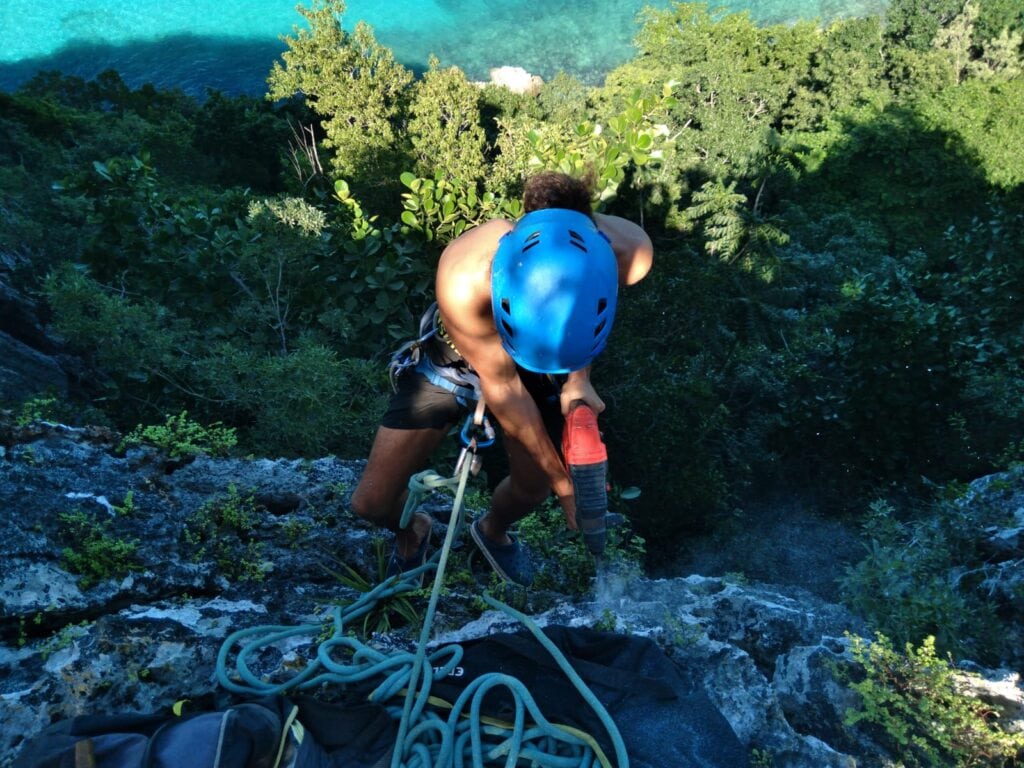
The project involves replacing deteriorated anchors with high-quality stainless steel fixings. Specifically, we are replacing old zinc-plated bolts and hangers with MTP-A4 anchors. In addition, we are adding protection points that could not be installed at the time due to lack of materials and optimizing the position of some anchors to improve safety, especially with beginner climbers in mind.
Which areas are priorities and why?
The priority areas are Discovery Bay and Coral Springs. Discovery Bay has special value because it was the first climbing area in the country, while Coral Springs is highly accessible and frequently visited by the local community.
Furthermore, as coastal sectors, they are the ones that have suffered the most from corrosion, which is why they require urgent intervention.
What are the characteristics of INDEX anchors?
The anchors used are MTP-A4, made entirely of A4 stainless steel, making them ideal for marine environments. They are designed to withstand C5-M corrosion conditions and are ETA certified, ensuring structural performance.
In a country where there is no federation regulating safety, having certified equipment provides great reassurance and raises the standard of the project.
The future of climbing in Jamaica
What impact does this project have on safety and the community?
The impact is comprehensive. On the one hand, it improves safety and brings the level of the installations in line with the best European crags. On the other, it strengthens the confidence of the local community and the credibility of the project.
It also helps attract international climbers, positioning Jamaica as a destination for the sport.
What would happen if this rebolting were not carried out?
Without this work, many of the current routes would become unsafe within a few years.
Corrosion would ultimately force the closure of entire sectors to prevent accidents, which would mean losing a fundamental part of the development of climbing in the country.
Thanks to INDEX, we are preventing the closure of two of the most emblematic sectors on the island.
What is the importance of working with certified materials in this type of project?
It is essential. In a rebolting project there is no margin for error. Using certified materials means guaranteeing safety not only in the present, but also for future generations of climbers in Jamaica.
Commitment to technical solutions with impact
The collaboration with Jamrock Climbing responds to the need to use solutions designed for highly corrosive environments such as marine sectors, where anchor reliability is critical.
This type of initiative is part of our range of climbing fixings, developed for applications such as climbing, caving or via ferrata, and designed to offer safe and durable performance under real conditions of use.
At the same time, it allows us to contribute to the development of projects with a direct impact on the ground, supporting the creation and maintenance of safe infrastructure that facilitates access to the sport and fosters the growth of local communities.